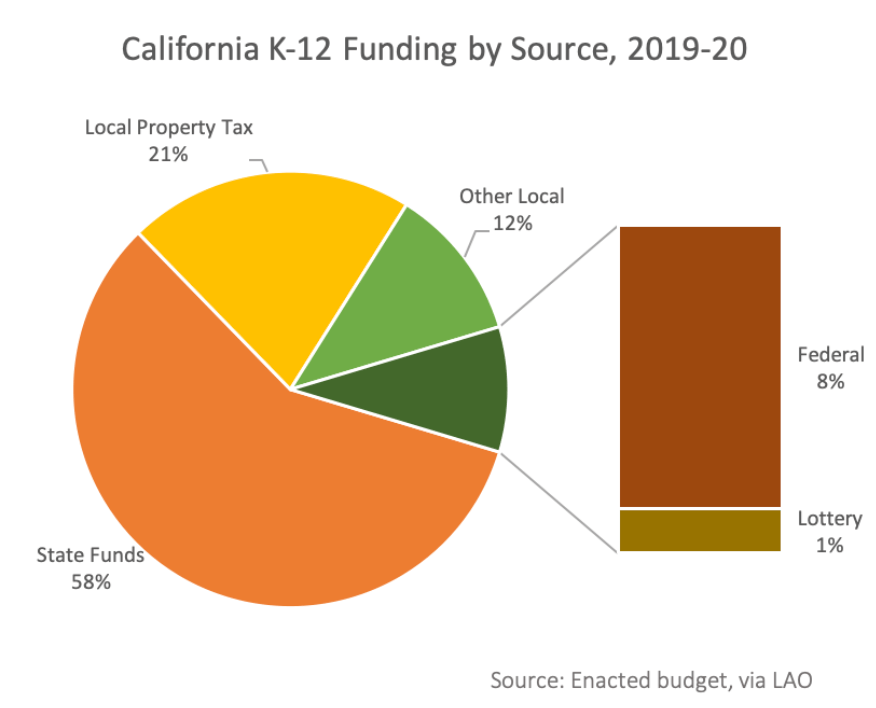
Since becoming an administrator, I think the question I am asked most about school funding is, “what happened to all the lottery money?” This question exemplifies the huge disconnect between the public, policymakers, and California’s education budget realities. When California voters passed Proposition 37 in 1984, they were excited at the prospect of millions of dollars being funneled into education without increasing taxes (8.3 Who Pays, 2021). With the lottery being so well advertised touting multimillion-dollar jackpots, the public is thinking large amounts of lottery funds are padding the school district’s budgets; they would be partially correct. According to the California Department of Education, in 2017-18 lottery funds totaling over 1.3 billion were given to K-12 schools (Lottery – CalEdFacts, 2020). Most people would think that over a billion dollars is a large amount, but when you look closely at that number it actually only amounts to just over $200 per student (Lottery – CalEdFacts, 2020). Lottery funds only account for 1% of school funding. Parents and community members are often shocked when I share that low amount.
They are even more shocked when I tell them that the $200 comes with strings attached. In March of 2000, the California voters passed Proposition 20 (Diaz, 2000). With that proposition, a portion of that lottery money must be allocated for the purchase of instructional materials. The exact formula is one-half of statewide growth in lottery funds over the level set in the 1997-98 fiscal year (California State Lottery Act, Proposition 37 (1984), n.d.). At the time of the proposition, voters were concerned because California is ranked 47th out of the 50 states in per-pupil spending (California State Lottery Act, Proposition 37 (1984), n.d.). Parents are even more shocked when I share that because the lottery money now has earmarks for instructional materials, the few hundred dollars per student is now split and around fifty of the two hundred dollars can only be used on instructional materials (Diaz, 2000). It is also important to note that the two-hundred dollars is dependent on Average Daily Attendance or ADA. This means that students who are chronically absent, will receive less in funding (Proposition 37: The California State Lottery Initiative, 1984).
While it may be reasonable to want to better the spending on instructional materials, the lottery money actually contributes very little to the enormous costs of materials. Similar to all things in education, purchasing of instructions materials is tied to laws and regulations. For example, textbooks/instructional materials must be adopted by the state board of education for school use. Textbook publishing is big business. Consider that according to the California Department of Education the average cost of a single textbook for students is $250 annually (Price List of Adopted Instructional Materials – Curriculum Frameworks & Instructional Materials, 2021). When researching the Price List of Adopted Instructional Materials, it appears that most materials at the junior high and high school level are closer to $800 per annum including the digital version of the textbook and the printed version. In the infographic below it outlines the rising costs of textbooks at all education levels.

California is on the bottom end of the spectrum when it comes to per-pupil spending across the board. California taxpayers believe they are contributing to schools through their property taxes and the lottery, and they are, but not to the levels they believe. The majority of school budgets no longer come from property taxes. Instead, most of California’s school funds come from State Aid captured through income taxes and another 8% is from federal funds (8.3 Who Pays, 2021). Federal funds come with earmarks and must only be used for the categorical programs tied to those funds; programs that often cost much more than the funds received. Voters have continuously supported the use of lottery funds as a supplement to the K-12 budget woes. Unfortunately, though the lottery is joyously making millionaires, it is really not making a significant impact on California’s budget. I can say that as a school administrator, I am grateful for every penny that comes to the school and am not suggesting that even 1% is not necessary, we need it all. California’s budget is complicated and inadequate and there is no quick fix in sight. For that reason, I believe I will continue to have these conversations with parents and community members for the foreseeable future. Maybe if I can educate a few more people, together we can find a way to un-complicate and better the budget. Until then, I will head out to buy my lottery ticket, pay my income taxes, and property taxes and vote for bonds, all in the hope (like the parents I am teaching about budgets) that by doing my part, schools will be funded adequately to meet the needs of the students.
Resources
8.3 Who Pays: Where California’s Public School Funds Come From. (2021, January). ED 100. https://ed100.org/lessons/whopays
California State Lottery Act, Proposition 37 (1984). (n.d.). Ballotpedia. Retrieved May 23, 2021, from https://ballotpedia.org/California_State_Lottery_Act,_Proposition_37_(1984)
Diaz, G. (2000). Proposition 20. University of the McGeorge School of Law. https://faculty.mcgeorge.edu/publications/california-initiative-review/initiatives-prior-to-november-2005/march-2000-initiatives/proposition-20
Lottery—CalEdFacts. (2020, June 25). CA Dept of Education. https://www.cde.ca.gov/fg/aa/lo/ceflottery.asp
Price List of Adopted Instructional Materials—Curriculum Frameworks & Instructional Materials. (2021, February 10). CA Dept of Education. https://www.cde.ca.gov/ci/cr/cf/intro-plsearch.asp
Proposition 37: The California State Lottery Initiative. (1984, August 22). Legislative Analyst’s Office. https://lao.ca.gov/Publications/Detail/3119
Zook, C. (2017, September 7). Infographic: Textbook Costs Skyrocket 812% in 35 Years. https://www.aeseducation.com/blog/infographic-the-skyrocketing-cost-of-textbooks-for-schools-students
 The Principal Has Homework